Diarrhea
"IBS" Describes What's Happening. It Doesn't Explain Why.
Chronic diarrhea affects 14 million Americans. Most receive a diagnosis of IBS, IBD, or Celiac Disease — labels that describe symptoms without identifying the biological driver. The right label doesn't stop the diarrhea. Finding the right cause does.
Diagnose the symptom. Medicate the output.
Standard medicine categorizes presentations into umbrella labels and prescribes medications that slow transit time or reduce inflammation. The label describes what's happening — not why the digestive system lost its regulatory capacity.
- "IBS" describes irregular bowel function — not its cause
- Medications mask the symptom while the underlying driver progresses
- Long-term symptom suppression increases diverticulitis and gut-barrier damage risk
- Abrupt medication changes cause severe rebound — never stop prescriptions without guidance
Eight specific biological drivers. One needs to be yours.
Chronic diarrhea always has a specific physiological origin — gastric inflammation, bile salt dysregulation, enzyme insufficiency, SIBO, dietary triggers, microbiome disruption, stress, or autoimmune activity. Finding yours is the only path to lasting resolution.
- Eight distinct, diagnosable root causes
- Each has a targeted, natural intervention protocol
- Multiple causes often overlap — the intersection is where resolution lives
- Resolving the root cause often resolves seemingly unrelated health issues
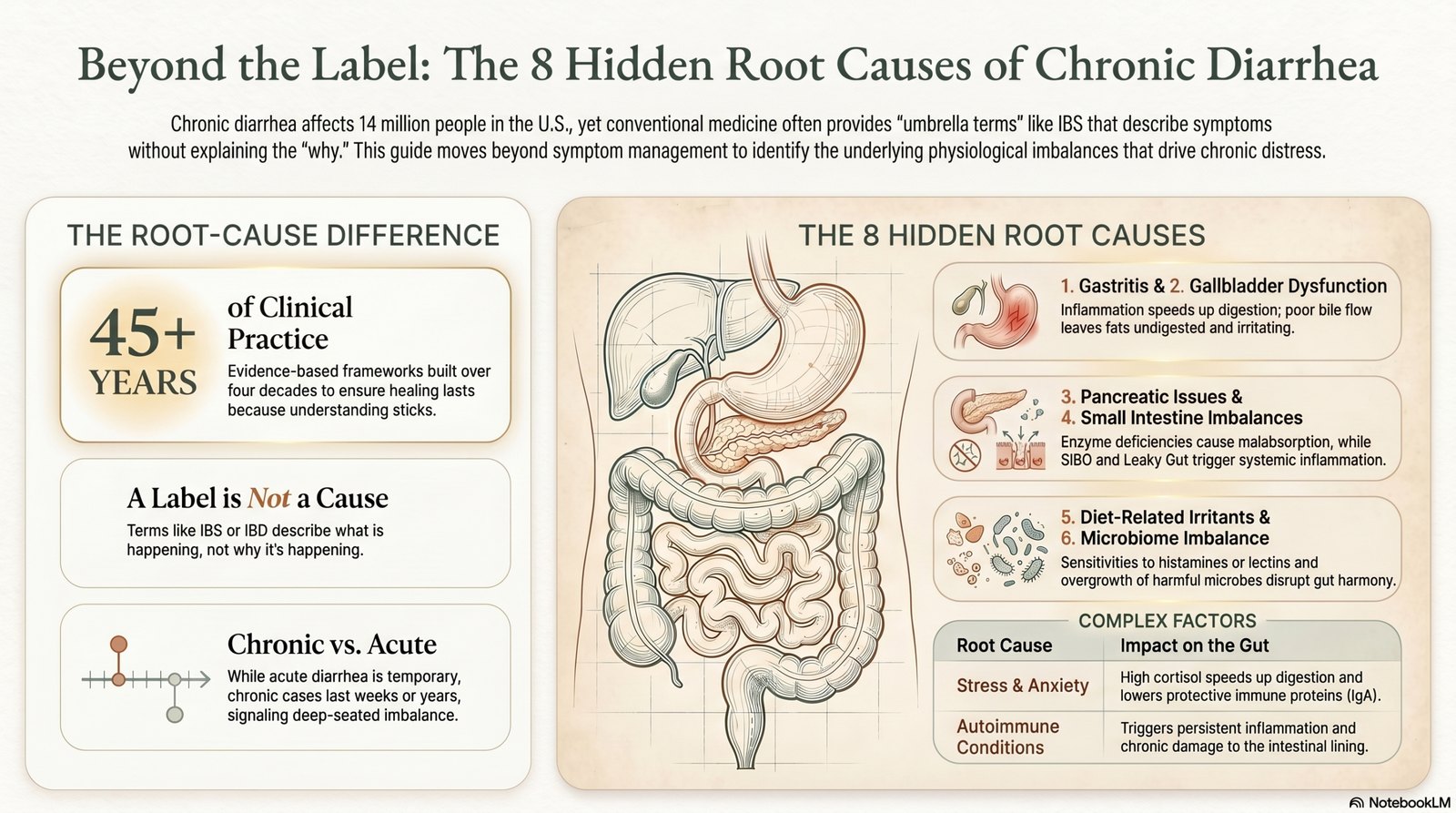
Find Your Specific Driver
Chronic diarrhea always has a specific biological origin — or a combination of origins. These eight categories cover every known functional driver. Identifying yours is the first step toward lasting resolution.
What it is
When the stomach lining is inflamed — from H. pylori infection, chronic NSAID use, or sustained stress — the body accelerates digestion as a protective reflex. It's attempting to flush the irritant out as quickly as possible. This "protective flush" becomes the mechanism of chronic diarrhea.
Symptoms
- Loose stools alongside heartburn or upper abdominal burning
- Diarrhea that worsens after NSAID use (ibuprofen, aspirin)
- Nausea alongside diarrhea, particularly in the morning
- History of H. pylori infection or ulcers
- Frequent association with GERD symptoms
Common causes
- H. pylori infection — the most common bacterial driver of gastric inflammation
- Chronic NSAID use — ibuprofen and aspirin erode the stomach lining with regular use
- Chronic stress — sustained cortisol damages the gastric mucosa
- Acid reflux (GERD) — stomach acid irritates the lining from the inside
Natural approach
- Address H. pylori with colloidal silver and aloe vera
- Eliminate NSAID use where possible; replace with anti-inflammatory alternatives under guidance
- Heal the stomach lining with aloe vera, DGL licorice, and zinc carnosine
- Resolve the upstream trigger — stress management is non-negotiable for gastritis
What it is
The gallbladder regulates bile release for fat digestion. When it malfunctions — or has been removed — two failure modes cause diarrhea. First: fat is incompletely digested and irritates the intestinal lining. Second: excess bile salts are released directly into the colon, where they act as an osmotic agent — drawing water in and triggering urgent, loose stools.
Symptoms
- Diarrhea specifically triggered by fatty or rich meals
- Onset or worsening of diarrhea after gallbladder removal (bile salt diarrhea)
- Yellow or greasy appearance to stools
- Right-sided abdominal discomfort or pressure
- Urgency — sudden, difficult-to-defer bowel movements
Common causes
- Gallbladder removal — bile is released unregulated directly into the small intestine
- Gallstones or sludge — impairs normal bile storage and controlled release
- Low-fat diet history — the gallbladder atrophies without regular fat-stimulated use
Natural approach
- For bile salt diarrhea post-removal, bile acid sequestrants may be needed under medical guidance
- Support remaining bile function with ox bile supplements and lipase enzymes
- Eat smaller, balanced meals with moderate fat to reduce the bile surge
- Beets, artichokes, and dandelion tea to support remaining bile flow
What it is
The pancreas produces the enzymes that disassemble proteins (protease), carbohydrates (amylase), and fats (lipase). When enzyme production is insufficient, undigested food particles move through the intestines and act as irritants — triggering diarrhea as the body attempts to expel them. Pale, greasy, floating stools are the hallmark clinical indicator.
Symptoms
- Pale, greasy, or oily stools that float (undigested fat)
- Foul-smelling stools — fermentation of undigested protein
- Diarrhea alongside significant fatigue after eating
- Weight loss despite adequate food intake — severe malabsorption
- Bloating and gas from fermentation of undigested remnants
Common causes
- Chronic pancreatitis or pancreatic stress — direct impairment of enzyme production
- Low stomach acid — acid is the signal that triggers enzyme release; no acid, no enzymes
- Chronic inflammation — inflammatory cytokines suppress pancreatic secretion
Natural approach
- Broad-spectrum digestive enzyme blend (protease, amylase, lipase) immediately before meals
- Address low stomach acid first — it is a prerequisite for enzyme activation
- Eat smaller meals to reduce the enzyme demand per sitting
- Consider prescription pancreatic enzymes (PERT) under medical guidance in severe cases
What it is
Two distinct small-intestine conditions drive diarrhea through different mechanisms. SIBO (Small Intestinal Bacterial Overgrowth) places bacteria in the wrong location — they ferment food prematurely, producing gas, inflammation, and accelerated transit. Leaky Gut compromises the intestinal barrier — toxins and undigested particles enter the bloodstream, trigger histamine release and immune activation, and the resulting inflammation drives diarrhea.
Symptoms
- SIBO: significant gas and bloating with diarrhea, even after small or healthy meals
- SIBO: brain fog or cognitive haziness after eating — microbial byproducts in the bloodstream
- Leaky Gut: diarrhea triggered or worsened by fermented foods, avocados, or high-histamine foods
- Leaky Gut: diarrhea alongside new food sensitivities, skin conditions, or joint pain
Common causes
- Low stomach acid — the primary barrier preventing bacterial migration into the small intestine
- Impaired motility — allows bacteria to establish in the small intestine
- Antibiotic use — disrupts the microbial balance that prevents SIBO
- Chronic stress and inflammation — degrades the intestinal tight junctions (leaky gut)
Natural approach
- For SIBO: restore stomach acid first, then support motility with ginger and peppermint
- For SIBO: consider antimicrobial herbs (oregano oil, berberine) under guidance
- For Leaky Gut: L-glutamine and zinc to repair tight junctions; remove high-histamine foods temporarily
- Support liver detoxification to clear the inflammatory load
What it is
Specific food components act as persistent immune triggers in susceptible individuals — not because the food is "bad" but because a compromised gut lining or immune dysfunction creates reactivity. Three categories drive diarrhea most commonly: histamines (immune triggers), lectins (gut-lining irritants), and oxalates (inflammatory compounds in certain plants).
Symptoms
- Diarrhea that consistently follows specific foods rather than all meals
- Reaction to fermented foods (aged cheese, wine, kefir) or avocados — histamine excess
- Reaction to legumes, beans, or whole grains — lectin sensitivity
- Reaction to spinach, almonds, beets, or chocolate — oxalate load
- Symptoms that improve on elimination but return with reintroduction
Common causes
- Histamine intolerance — depleted DAO enzyme (diamine oxidase) that normally breaks down dietary histamine
- Lectin sensitivity — leaky gut allows lectins to bind to intestinal receptors and trigger inflammation
- Oxalate sensitivity — often secondary to gut dysbiosis (specific bacteria normally metabolize oxalates)
Natural approach
- Systematically eliminate suspected trigger categories for 3–4 weeks and track response
- For histamine intolerance: DAO enzyme supplementation and a low-histamine diet
- For lectin sensitivity: pressure-cook legumes (destroys most lectins) or eliminate while healing the gut
- Restore gut bacteria that metabolize oxalates (Lactobacillus acidophilus, Bifidobacterium)
What it is
The gut microbiome is a finely balanced ecosystem. When harmful bacteria, yeast overgrowth (Candida), or parasites establish dominance — from antibiotic use, food poisoning, or exposure to new pathogens during travel — they disrupt the ecosystem required for normal transit and absorption. This is one of the most common causes of chronic diarrhea that begins with a clear triggering event.
Symptoms
- Chronic diarrhea that began suddenly after a specific event — antibiotics, food poisoning, or travel
- Alternating diarrhea and constipation
- Strong sugar or carbohydrate cravings (Candida overgrowth demands sugar)
- Bloating alongside loose stools — gas from microbial fermentation
- Fatigue and brain fog out of proportion to other symptoms
Common causes
- Antibiotic use — kills beneficial bacteria, allowing harmful species to overgrow rapidly
- Food poisoning — pathogenic bacteria temporarily displace the healthy ecosystem
- International travel — exposure to unfamiliar pathogens, some of which persist
- High-sugar diet post-antibiotics — feeds Candida during the vulnerable recolonization period
Natural approach
- Targeted multi-strain probiotics (Lactobacillus and Bifidobacterium) to recolonize beneficial species
- For yeast/Candida: antifungal herbs (caprylic acid, oregano oil) alongside strict sugar reduction
- For parasites: comprehensive stool testing followed by targeted antimicrobial protocols
- Prebiotic foods (garlic, onion, asparagus) to feed beneficial bacteria during restoration
What it is
The gut and brain are in constant two-way communication via the vagus nerve and the enteric nervous system. When stress activates the fight-or-flight response, cortisol floods the system and accelerates digestive transit — "clearing the decks" for survival. Simultaneously, chronic stress depletes Secretory IgA (sIgA) — the gut's primary immune defense — leaving the intestinal lining increasingly vulnerable and reactive.
Symptoms
- Diarrhea that reliably worsens during high-stress periods or before anxiety-provoking events
- Morning urgency — cortisol peaks in the early morning and triggers early evacuation
- Diarrhea that improves noticeably during vacation, rest, or relaxation
- Low sIgA on stool testing — measurably depleted gut immunity
- Anxiety, sleep disruption, and digestive instability that move together
Common causes
- Chronic occupational or relational stress — sustained cortisol directly accelerates transit
- Anxiety disorders — the gut-brain axis is hypersensitive, amplifying motility signals
- Poor sleep — the primary cortisol recovery window; poor sleep means chronically elevated cortisol
Natural approach
- Vagus nerve stimulation before meals — deep breathing, humming, cold water on the face
- Adaptogenic herbs (ashwagandha, rhodiola) under guidance to modulate the cortisol response
- Rebuild sIgA with colostrum, L-glutamine, and zinc
- A consistent sleep schedule — cortisol cannot normalize without adequate recovery sleep
What it is
Autoimmune conditions like Crohn's disease and Ulcerative Colitis represent the most severe end of the chronic diarrhea spectrum. In these cases, the immune system is actively attacking the intestinal tissue — driving high-level, persistent inflammation, severe malabsorption, and tissue damage. These conditions require specialized medical management alongside functional support.
Symptoms
- Severe, persistent diarrhea often with blood or mucus in stool
- Significant abdominal cramping and pain alongside diarrhea
- Unexplained weight loss — severe malabsorption
- Fatigue and anemia from nutrient depletion
- Systemic inflammation: joint pain, skin conditions, eye inflammation
Important note
Autoimmune IBD requires medical diagnosis and ongoing clinical supervision. The natural approaches below are supportive strategies to be used alongside — never instead of — your physician's prescribed protocol.
Supportive natural approach
- Anti-inflammatory diets (SCD, low-FODMAP, or IBD-AID) under dietitian supervision
- L-glutamine to support intestinal-barrier repair during remission periods
- Targeted probiotics (VSL#3, Saccharomyces boulardii) shown to support IBD remission
- Stress management as relapse prevention — cortisol is a known flare trigger
- Nutrient repletion (B12, iron, vitamin D, zinc) given the severe malabsorption profile
Find Your Root Cause by Pattern
The specific character of the diarrhea — timing, stool appearance, associated symptoms, and triggering events — maps directly to the most likely root cause.
| Root Cause | Timing of Discomfort | Key Differentiating Symptoms | Common Triggers |
|---|---|---|---|
Gastritis |
After meals, with heartburn | Upper abdominal burning, nausea, NSAID history | H. pylori, NSAIDs, chronic stress, GERD |
Gallbladder Dysfunction |
Specifically after fatty meals | Greasy stools, right-side pressure, urgency | Gallbladder removal, gallstones, low-fat diet |
Pancreatic Insufficiency |
After eating, with fatigue | Pale greasy floating stools, weight loss | Chronic pancreatitis, low stomach acid |
SIBO / Leaky Gut |
After meals + fermented foods | Gas, bloating, brain fog, histamine reactions | Low stomach acid, antibiotics, stress |
Dietary Irritants |
After specific trigger foods | Pattern-specific: fermented foods, legumes, or oxalates | Histamine intolerance, lectin/oxalate sensitivity |
Microbiome Imbalance |
Chronic since triggering event | Sugar cravings, bloating, began after antibiotics/travel | Antibiotics, food poisoning, international travel |
Stress & Anxiety |
During stress, morning urgency | Improves on vacation, low sIgA, anxiety co-present | Chronic stress, poor sleep, cortisol elevation |
Autoimmune (Crohn's/UC) |
Persistent, often with pain | Blood or mucus in stool, weight loss, systemic inflammation | Autoimmune activation — requires medical management |
Chronic Diarrhea
Hits Purge
& Solutions
Recommendations
Diarrhea — Common Questions
What causes Diarrhea?
Can Gastritis cause Diarrhea?
Can Gallbladder Dysfunction cause Diarrhea?
Can SIBO / Leaky Gut cause Diarrhea?
Can Microbiome Imbalance cause Diarrhea?
Can Stress & Anxiety cause Diarrhea?
Choose Your Path Forward
Every journey to gut health looks different. Here's how to start in exactly the right place for you.