Constipation
Laxatives Move Waste. They Don't Fix What Stopped It.
Constipation affects 63 million Americans — and the most common response is a laxative. That's treating the exhaust, not the engine. Long-term laxative use doesn't just fail to fix the problem; it makes it permanent.
Laxatives force output without restoring function.
Laxatives temporarily move waste without addressing the underlying mechanics. Long-term dependency leads to serious downstream complications — the very conditions people are trying to avoid.
- Does not restore peristalsis or motility
- Does not address dehydration, enzyme deficiency, or dysbiosis
- Long-term use leads to IBS and diverticulitis risk
- Creates a cycle of dependency — the colon stops self-regulating
Ten specific root causes. One needs to be yours.
Constipation is always caused by something specific — dehydration, low stomach acid, mineral deficiency, thyroid dysfunction, dysbiosis, or one of seven other identifiable drivers. Find the right one and regularity restores itself.
- Ten distinct, diagnosable root causes
- Each cause has a targeted, natural intervention
- The goal is restoration of function, not forced movement
- Resolving the root cause often resolves broader health issues
What's Your Hydration Score?
Dehydration is the most common — and most overlooked — driver of constipation. Answer four quick questions to see your daily water target and where you stand today.
Enter your body weight and water intake to see your Hydration Score.
Educational estimate only — not medical advice. Individual needs vary with climate, medication, and health conditions. See the clinical references at the bottom of this page.
Find Your Specific Driver
Constipation is never just one thing. But it always has a specific physiological origin. Identifying which of these ten drivers — or which combination — applies to you is the first step toward permanent relief.
What it is
The colon's job is to reabsorb water from digested food. In a well-hydrated body, this is balanced. When the body is dehydrated, the colon extracts every available drop of moisture from waste before it can be eliminated — leaving stool hard, dry, and difficult to pass.
Symptoms
- Hard, dry stools that require significant straining
- Infrequent bowel movements (fewer than 3 per week)
- Worsens with caffeine, alcohol, or intense physical activity
- Headaches and dark urine alongside constipation
Common causes
- Insufficient daily water intake — most people are chronically under-hydrated
- High caffeine or alcohol consumption — both are diuretics that accelerate water loss
- Electrolyte imbalance — water without minerals passes through without cellular absorption
Natural approach
- Aim for 10–15 cups of water daily, sipped throughout the day rather than all at once
- Add a pinch of Himalayan or Redmond's natural salt to water to enhance mineral absorption
- Avoid large bolus water consumption — sipping is more effective for hydration
- Reduce caffeine and alcohol, which accelerate dehydration
What it is
Fiber provides the bulk that moves stool through the intestines. Healthy fats stimulate bile production — the digestive tract's primary lubricant. A diet low in either creates a sluggish, difficult-to-move stool that sits and hardens in the colon.
Symptoms
- Feeling of heaviness or fullness after meals
- Slow, infrequent bowel movements
- Stool that is well-formed but difficult to pass
- Worsens on low-fat or very low-carbohydrate diets
Common causes
- Processed food diet — low in fiber and healthy fats, high in refined carbohydrates
- Low-fat diet — insufficient dietary fat to stimulate bile release
- Insufficient vegetables and fruits — the most common fiber gap
Natural approach
- Incorporate fiber-rich foods — leafy greens, berries, beans, oats, and flaxseed
- Pair with healthy fats — olive oil, avocados, and nuts — to stimulate bile flow
- Introduce fiber increases gradually to avoid overwhelming gut microbes
What it is
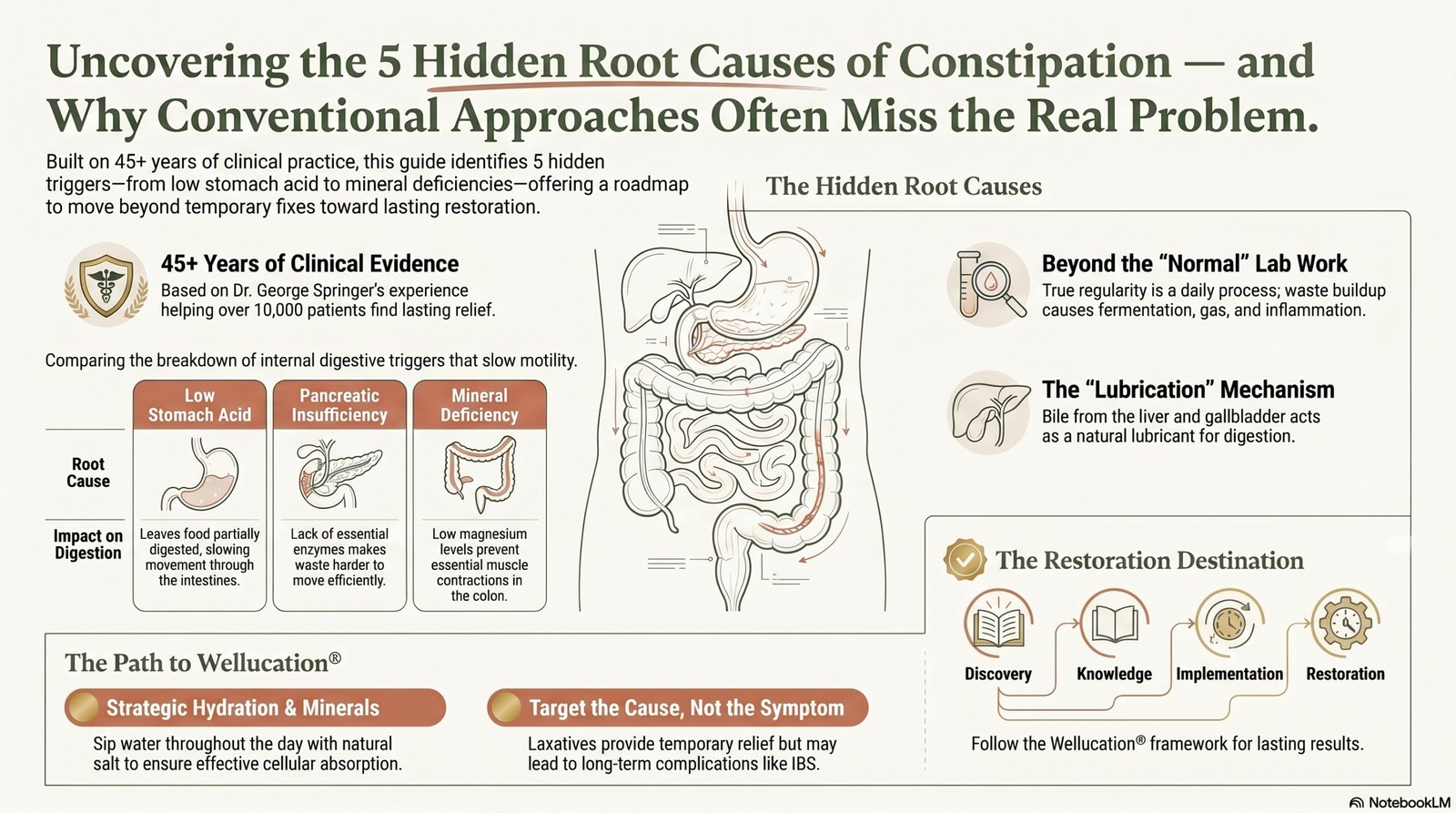
Low stomach acid means food isn't properly broken down before it leaves the stomach. Partially digested food moves slowly and inefficiently through the entire digestive tract — creating a "traffic jam" that backs up into constipation. Antacid overuse and excessive water during meals are primary accelerants.
Symptoms
- Bloating and gas alongside constipation
- Feeling like food sits in your stomach for too long
- Belching or burping after meals
- Worsened by antacid use or large volumes of water with meals
- Nutrient deficiencies despite eating well
Common causes
- Antacid and PPI overuse — the most common iatrogenic cause
- Chronic stress — suppresses acid production as "non-essential"
- Aging — acid-producing cells decline over time
Natural approach
- Take a small amount of apple cider vinegar or HCl with pepsin before meals
- Avoid drinking large amounts of water during meals — it dilutes stomach acid
- Address the root cause of low acid — stress, aging, or medication — alongside supplemental support
What it is
Bile is the digestive tract's lubricant. Produced by the liver and stored in the gallbladder, bile emulsifies fats and lubricates stool for smooth passage. When bile flow is reduced — from gallbladder dysfunction, liver stress, or a low-fat diet — the digestive system loses its primary lubricant and stool stalls.
Symptoms
- Sluggish digestion and constipation after heavier meals
- Difficulty processing fatty or rich foods
- Right-side abdominal discomfort or pressure
- Pale or clay-colored stools (severe bile deficiency)
- Worsens on vegetarian or very low-fat diets
Common causes
- Low-fat diet — fat is the primary stimulus for bile release; no fat, no bile
- Gallbladder dysfunction — bile thickens or flow becomes sluggish
- Liver stress — an overburdened liver produces less bile
Natural approach
- Incorporate healthy fats at each meal to stimulate bile release
- Support bile flow with beets, artichokes, dandelion tea, and digestive bitters
- Bile salt supplements can assist when gallbladder function is compromised
- Hydrate well to keep bile thin and flowing
What it is
The pancreas produces three essential enzymes: protease (breaks down protein), amylase (breaks down carbohydrates), and lipase (breaks down fats). When enzyme production is insufficient, food is never fully processed. The undigested remnants accumulate in the intestines, slow transit, and create the compaction that causes constipation.
Symptoms
- Chronic digestive lag — food takes far too long to move through
- Fatigue and heaviness after eating
- Undigested food visible in stools
- Bloating and gas from fermentation of undigested remnants
Common causes
- Chronic stress and inflammation — impairs pancreatic secretion
- Processed food diet — overloads enzyme production capacity
- Low stomach acid — acid signals enzyme release; no acid, no enzymes
Natural approach
- Use a broad-spectrum digestive enzyme blend (protease, amylase, lipase) before meals
- Practice thorough chewing — mechanical breakdown reduces the enzyme burden
- Address low stomach acid first, as enzymes are only released when acid levels are adequate
What it is
Food sensitivities — particularly to dairy, gluten, and sugar — trigger inflammation in the intestinal lining. This inflammation causes swelling that narrows the digestive tract, obstructing the smooth passage of waste. Unlike food allergies, sensitivities often produce delayed reactions that are difficult to connect to specific foods.
Symptoms
- Constipation alternating with diarrhea — the gut cycling between inflammation and relief
- Abdominal discomfort or cramping after specific foods
- Bloating and gas following meals containing dairy, gluten, or sugar
- Skin conditions, joint pain, or brain fog alongside constipation
Common causes
- Leaky gut — a compromised intestinal lining allows immune-triggering particles through
- Antibiotic use — damages the gut lining and disrupts protective bacteria
- Chronic processed food diet — inflammatory ingredients accumulate
Natural approach
- Identify and eliminate trigger foods — dairy, gluten, and sugar are the most common
- Support gut-lining repair with bone broth or L-glutamine
- Reduce systemic inflammation through liver-detoxification support
- Reintroduce eliminated foods one at a time after a 4–6 week elimination period
What it is
The gut microbiome plays a direct role in motility — the muscular contractions that move waste through the intestines. When beneficial bacteria are depleted by sugar, antibiotics, or chronic stress, motility slows and harmful species dominate. The result is a sluggish, unpredictable digestive system.
Symptoms
- Sluggish motility — food moves slowly through the entire tract
- Strong sugar or carbohydrate cravings (harmful microbes demand their preferred food)
- Alternating constipation and loose stools
- Bloating and fermentation throughout the day
- History of antibiotic use with constipation that began or worsened afterward
Common causes
- Antibiotic use — kills beneficial bacteria, allowing harmful overgrowth
- High sugar diet — feeds yeast and harmful bacteria while starving beneficial species
- Chronic stress — alters the gut-brain axis and shifts microbial composition
Natural approach
- Replenish beneficial bacteria through a high-quality multi-strain probiotic
- Feed them with prebiotic foods — bananas, onions, garlic, leeks, and asparagus
- Reduce sugar and processed food consumption
- Fermented foods (kefir, kimchi, sauerkraut) accelerate microbiome restoration
What it is
Magnesium is the critical mineral for peristalsis — the rhythmic muscular contractions that move waste through the colon. Without adequate magnesium, the colon cannot contract efficiently. The body also prioritizes mineral absorption so strongly that it will extract minerals (along with water) from stool rather than allow deficiency — leaving stools dry and hard.
Symptoms
- Constipation alongside muscle cramps or spasms
- General fatigue and sluggishness
- Hard, dry stools even with adequate water intake
- Restless sleep or difficulty staying asleep
Common causes
- Processed food diet — stripped of natural minerals during manufacturing
- High stress lifestyle — stress depletes magnesium rapidly
- Excessive caffeine or alcohol — both promote magnesium excretion
- Certain medications — diuretics and PPIs deplete magnesium
Natural approach
- Supplement with magnesium glycinate or magnesium citrate — both highly bioavailable
- Add natural salt (Himalayan or Redmond's) to water to replace electrolytes
- Increase magnesium-rich foods: dark leafy greens, pumpkin seeds, dark chocolate, legumes
What it is
The thyroid regulates the metabolic pace of every system in the body — including digestion. When the thyroid is underactive (hypothyroidism), the entire digestive process slows. The colon contracts less frequently, transit time increases dramatically, and constipation becomes chronic and resistant to dietary interventions.
Symptoms
- Chronic constipation alongside persistent fatigue
- Unexplained weight gain or difficulty losing weight
- Dry skin, hair thinning, and feeling cold easily
- Brain fog and mental sluggishness
- Constipation that doesn't respond to hydration or dietary changes
Common causes
- Iodine or selenium deficiency — both essential for thyroid hormone production
- Chronic stress — cortisol suppresses thyroid function directly
- Autoimmune thyroiditis (Hashimoto's) — the immune system attacks thyroid tissue
- Environmental toxins — fluoride, bromide, and chlorine displace iodine
Natural approach
- Request a comprehensive thyroid panel including T3, T4, and reverse T3 — TSH alone misses many cases
- Under clinical guidance, support thyroid function with iodine and selenium
- Address adrenal stress (cortisol) first, since adrenal dysfunction suppresses the thyroid
What it is
The nervous system has two modes: fight-or-flight (sympathetic) and rest-and-digest (parasympathetic). Digestion requires the parasympathetic state. When chronic stress keeps the body in fight-or-flight, the nervous system deprioritizes digestion as "non-essential" — gut motility halts, cortisol suppresses the thyroid, and constipation becomes a direct physiological symptom of stress.
Symptoms
- Constipation that worsens noticeably during high-stress periods
- Immediate digestive disruption during acute stress events
- Chronic constipation in high-pressure professional environments
- Alongside anxiety, poor sleep, and general tension
Common causes
- Chronic occupational stress — sustained cortisol elevation is the mechanism
- Poor sleep hygiene — the body uses sleep to restore parasympathetic function
- Lack of movement — physical activity is one of the most effective stress regulators
Natural approach
- Deep breathing and vagus-nerve stimulation before meals to activate the parasympathetic state
- A consistent morning bathroom routine to train the body's natural circadian rhythm
- 10-minute walks after meals to stimulate peristalsis
- 7–9 hours of quality sleep as a non-negotiable foundation
Find Your Root Cause by Pattern
Use the timing, accompanying symptoms, and dietary patterns to identify which of the ten drivers is at work for you.
| Root Cause | Timing of Discomfort | Key Differentiating Symptoms | Common Triggers |
|---|---|---|---|
Dehydration |
Always / chronic | Hard dry stools, headaches, dark urine | High caffeine/alcohol, low water intake |
Dietary Imbalance |
Chronic / gradual onset | Heavy feeling after meals, slow transit | Low fiber, low-fat, or processed food diet |
Low Stomach Acid |
After meals + throughout day | Bloating, gas, belching alongside constipation | Antacid overuse, stress, aging |
Liver / Gallbladder |
After fatty or heavier meals | Sluggish digestion, right-side discomfort | Low-fat diet, gallbladder dysfunction |
Pancreatic Deficiency |
Hours after eating | Fatigue, undigested food in stools, chronic lag | Processed food, stress, low stomach acid |
Food Sensitivities |
After specific trigger foods | Constipation/diarrhea cycling, abdominal cramping | Dairy, gluten, sugar |
Dysbiosis |
Chronic / unpredictable | Sugar cravings, sluggish motility, antibiotic history | Antibiotics, sugar, stress |
Mineral Deficiency |
Chronic | Dry stools even with hydration, muscle cramps, fatigue | Processed food, stress, caffeine |
Thyroid Dysfunction |
Chronic + resistant | Fatigue, weight gain, dry skin, cold sensitivity | Iodine/selenium deficiency, stress, autoimmune |
Stress |
During high-pressure periods | Worsens with stress, improves on vacation or rest | Sustained cortisol, poor sleep, no movement |
Constipation
Slows Down
& Solutions
Recommendations
Constipation — Common Questions
What causes Constipation?
Can Dehydration cause Constipation?
Can Dietary Imbalance cause Constipation?
Can Low Stomach Acid cause Constipation?
Can Mineral Deficiency cause Constipation?
Can Thyroid Dysfunction cause Constipation?
Choose Your Path Forward
Every journey to gut health looks different. Here's how to start in exactly the right place for you.
The Research Behind This Guide
-
Derivation and Internal Validation of a Score to Predict Dehydration Severity (National Library of Medicine, PMC)
Percent Dehydration = 100% × [(Stable Weight − Admission Weight) ÷ Stable Weight] — the clinical gold-standard measure of hydration status.
-
The Water Intake Calculator — daily fluid-requirement methodology
Basis for the personalized daily water target in the Hydration Score tool above.