Gas & Bloating
Your Gut Is a Symphony. One Wrong Note Disrupts Everything.
Gas and bloating aren't random. They're your body signaling that something in the digestive chain is out of tune — and treating the symptom without finding the disruptor just makes it worse.
Gas drops and antacids mask the signal.
Standard approaches suppress the symptom without identifying which part of the digestive chain failed. The bloating returns — often worse — because the root cause is never addressed.
- Gas drops don't restore digestive function
- Antacids worsen the upstream failure that caused the bloating
- Eliminating fiber often removes beneficial food without fixing anything
- Symptoms return within hours or days
Digestion is upstream and downstream.
When stomach acid, bile, or enzyme production fails upstream, everything downstream ferments, inflames, and bloats. Fix the right section of the orchestra and the whole system comes back into tune.
- Seven distinct disruptors — each needs a different fix
- Upstream failures (stomach, pancreas, gallbladder) guarantee downstream chaos
- The right intervention creates lasting relief, not temporary quiet
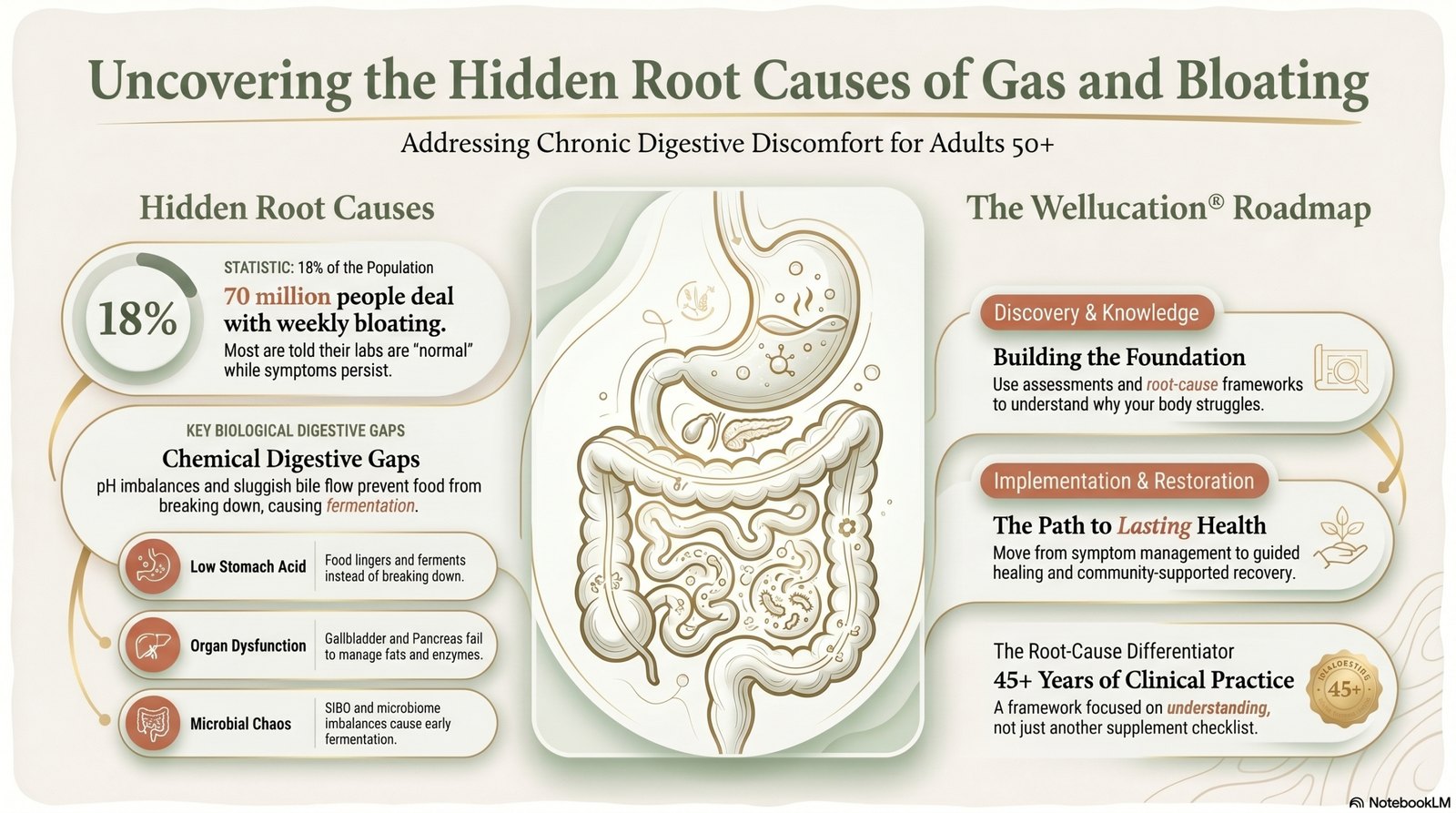
- 18% of people bloat weekly — almost none know which of the 7 causes is theirs
Find Your Disruptor
Gas and bloating have seven distinct biological origins. Identifying which one — or which combination — applies to you is the only path to lasting relief.
What it is
A healthy stomach functions as a high-efficiency acid bath at pH 1.5 to 2.0. When acidity drops — from stress, aging, or acid-blocking medication — food stops breaking down and starts fermenting. That fermentation is the gas.
Symptoms
- Feeling like you swallowed a beach ball after eating
- Belching or burping soon after meals
- Bloating that builds throughout the day
- Candida overgrowth or recurring yeast issues
- Chronic fatigue and nutrient deficiencies
Common causes
- Chronic stress — shuts down acid production as a "non-essential" function
- Aging — acid-producing cells naturally decline over time
- Acid-blocking medications — PPIs and antacids directly suppress production
Natural approach
- Apple cider vinegar immediately before meals to lower gastric pH
- Slow, relaxed eating — the vagus nerve signals acid production
- Vagus nerve stimulation: deep breathing, humming, or gargling before meals
- Avoid drinking large amounts of water during meals — it dilutes stomach acid
- Digestive enzymes with HCl to support the transition
What it is
The gallbladder stores bile — the body's "dish soap" for fats. When bile flow becomes thick or sluggish, fat digestion breaks down completely. Undigested fats clog the digestive pipes and trigger systemic inflammation.
Symptoms
- Bloating or nausea specifically after rich, fatty meals
- Dull ache or pressure under the right rib cage
- Sluggishness and fatigue after eating
- Light-colored or greasy stools
- Intolerance to fried foods or dairy
Common causes
- Low stomach acid — impairs the hormones that trigger bile release (secretin, CCK)
- Dehydration — bile thickens without adequate water
- High-fat, low-movement diet — bile stagnates without regular stimulation
- Gallbladder removal — uncontrolled bile release without storage regulation
Natural approach
- Beets, lemons, artichokes, and dandelion tea — natural bile movers
- Increased daily hydration to keep bile thin and flowing
- Smaller, more balanced meals to reduce the bile demand per sitting
- Avoid large, high-fat meals in a single sitting
What it is
The pancreas is the digestive factory — responsible for producing the enzymes that disassemble proteins, carbohydrates, and fats into absorbable nutrients. Without enough enzymes, food runs through the gut "unclean." The undigested remnants ferment downstream and cause gas.
Symptoms
- Bloating and indigestion developing well after a meal (not immediately)
- Fatigue after eating — the body working overtime on undigested food
- Undigested food visible in stools
- Feeling full or uncomfortable for hours after eating
- Nutritional deficiencies despite eating well
Common causes
- Chronic stress and inflammation — impairs pancreatic secretion
- Poor diet high in processed food — overloads and exhausts enzyme production
- Low stomach acid — acid triggers the signal for pancreatic enzyme release
- Aging — enzyme production declines naturally over time
Natural approach
- Thorough chewing — mechanical breakdown reduces the enzyme demand
- Broad-spectrum digestive enzyme supplement taken with meals
- Mindful eating in a relaxed state — stress suppresses enzyme secretion
- Address low stomach acid first — enzymes won't activate properly without it
What it is
The digestive tract is a carefully zoned city. The vast majority of gut bacteria should live in the large intestine. When bacteria migrate north into the small intestine — a neighborhood not designed for high microbial density — they start fermenting food before it's ready. The result is immediate gas after almost anything you eat.
Symptoms
- Bloating that starts within minutes of eating — even small amounts
- Gas after vegetables, grains, or "healthy" foods
- Brain fog or cognitive haziness after meals (microbial byproducts enter the bloodstream)
- Alternating constipation and diarrhea
- Symptoms that don't respond to dietary changes
Common causes
- Low stomach acid — acid is the primary barrier preventing bacterial migration north
- Impaired motility — the cleansing wave (migrating motor complex) fails to sweep bacteria downstream
- Antibiotics — disrupt the bacterial balance and allow overgrowth to establish
- Structural issues — adhesions or anatomical changes can trap bacteria in the small intestine
Natural approach
- Restore stomach acid — the most important upstream fix
- Ginger and peppermint — improve intestinal motility and discourage northward migration
- Motility support herbs to keep food and bacteria moving in the right direction
- Address the root cause first; SIBO returns without it
What it is
The intestinal lining should function as a fine mesh screen — selectively absorbing nutrients while keeping large particles out. When the lining is damaged (leaky gut), it becomes more like a chain-link fence. Undigested particles enter the bloodstream, the immune system treats them as invaders, and the resulting inflammation produces chronic bloating alongside seemingly unrelated symptoms.
Symptoms
- Developing new sensitivities to foods that never caused problems before
- Chronic bloating without a clear dietary trigger
- Skin conditions: eczema, acne, hives
- Joint pain and systemic inflammation
- Fatigue unrelated to sleep quality
Common causes
- Antibiotic use — damages gut flora and the intestinal lining directly
- Glyphosate and environmental toxins — disrupt tight junctions in the lining
- Chronic stress — cortisol degrades the intestinal barrier over time
- Processed foods and sugar — feed harmful microbes that erode the lining
Natural approach
- L-glutamine and zinc — targeted nutrients that repair the intestinal lining
- Remove identified trigger foods for a minimum of 4–6 weeks
- Support liver detoxification — the liver clears the inflammatory load from leaky gut
- High-quality probiotics to re-establish a protective microbial barrier
What it is
Fiber is essential for long-term gut health — but introducing high-fiber loads into an already-compromised system is like throwing too much wood on a struggling campfire. The microbes go into overdrive, producing excessive gas before the gut can adapt. This is especially common when people try to "eat healthy" but have an underlying digestive imbalance.
Symptoms
- Significant gas and bloating specifically after vegetables, beans, or whole grains
- Symptoms that get worse the "healthier" you eat
- Excessive heat and gas production within 1–2 hours of eating fiber
- Bloating that improves with a low-fiber diet but returns when fiber is reintroduced
Common causes
- Sudden fiber increase — the gut microbiome cannot adapt fast enough
- Underlying SIBO or dysbiosis — bacteria in the wrong place over-ferment fiber
- Insufficient enzyme production — fiber-digesting enzymes are depleted
Natural approach
- Cook vegetables to reduce fermentable fiber content and ease the digestive burden
- Introduce fiber increases gradually — small increments over weeks
- Balance intake with adequate water and digestive enzymes
- Address any underlying SIBO or dysbiosis first — fiber becomes manageable once bacteria are in the right place
What it is
The large intestine is an internal rainforest — home to trillions of microbes that must maintain high diversity to function. When beneficial species retreat due to antibiotics, stress, alcohol, or processed food, harmful species dominate. The result is a perpetually unsettled gut that ferments unpredictably and responds poorly to almost everything you eat.
Symptoms
- Chronic, unpredictable bloating and fermentation
- Reactions to a wide variety of foods without a clear pattern
- History of antibiotic use with digestive problems that never fully resolved
- Fatigue, brain fog, and mood disruption alongside gut symptoms
- Stools that are frequently loose, hard, or inconsistent
Common causes
- Antibiotics — the single most disruptive force on microbiome diversity
- Processed foods and sugar — feed harmful species while starving beneficial ones
- Alcohol — directly toxic to beneficial microbes at even moderate levels
- Chronic stress — alters the gut-brain axis and shifts microbial composition
Natural approach
- Prebiotics: onions, garlic, bananas, leeks, asparagus — feed the beneficial species
- Fermented foods: kefir, kimchi, sauerkraut, yogurt — reintroduce living cultures
- High-quality, multi-strain probiotic supplement
- Remove sugar and processed snacks — starve the harmful species out
- Consistency over time: microbiome restoration takes months, not days
Find Your Root Cause by Pattern
Gas and bloating have seven distinct biological origins. Use the timing, location, and pattern of your symptoms to identify which disruptor — or combination — is at work.
| Root Cause | Timing of Discomfort | Key Differentiating Symptoms | Common Triggers |
|---|---|---|---|
Low Stomach Acid |
During or soon after meals | Beach ball sensation, belching, candida | Stress, aging, acid-blocking medications |
Gallbladder Dysfunction |
After fatty or rich meals | Nausea, right rib pressure, greasy stools | High-fat meals, dehydration, gallbladder removal |
Pancreatic Deficiency |
Hours after eating | Fatigue, fullness, undigested food in stools | Stress, processed food diet, low stomach acid |
SIBO |
Within minutes of eating | Immediate bloating, brain fog, even with healthy food | Prior antibiotics, low motility, low stomach acid |
Leaky Gut |
Unpredictable / delayed | New food sensitivities, skin issues, joint pain | Antibiotics, glyphosate, chronic stress |
High Fiber / Starches |
1–2 hours after fiber-rich meals | Worse when eating "healthy," excessive gas and heat | Sudden fiber increase, underlying SIBO |
Microbiome Imbalance |
Chronic / unpredictable | Reacts to most foods, history of antibiotics | Antibiotics, sugar, alcohol, processed foods |
Gas & Bloating
Chain
& Solutions
Recommendations
Gas & Bloating — Common Questions
What causes Gas & Bloating?
Can pH Imbalance cause Gas & Bloating?
Can Sluggish Bile Flow cause Gas & Bloating?
Can Enzyme Deficiency cause Gas & Bloating?
Can Bacterial Overgrowth cause Gas & Bloating?
Can Immune-Mediated cause Gas & Bloating?
Can Microbial Overdrive cause Gas & Bloating?
Can Large Intestine Dysbiosis cause Gas & Bloating?
Choose Your Path Forward
Every journey to gut health looks different. Here's how to start in exactly the right place for you.